A Local TV Station’s Preservationist Side

Why KETV in Omaha moved in to the city’s beloved 120-year-old train station.
For nearly 40 years, Omaha’s historic Burlington Train Station collected dust. After Amtrak moved its passenger terminal into a small, forgettable structure right outside the historic building in 1974, pigeon feathers covered the mosaic floor of the grand hall and graffiti artists used its walls to practice their skills. During the winter, many of Omaha’s homeless population sought refuge in the abandoned building just blocks south of downtown. Meanwhile, on the other side of its tracks, Union Station, which stopped serving passengers in 1971, was swiftly converted into a history museum.
Burlington Station was on the verge of being unsalvageable until suddenly, in 2015, the station was brought back to life. After two years and $22 million of renovations, local ABC-affiliate KETV moved in. The station has been broadcasting the evening news, live, from Burlington Station ever since.
In the first two months after the historic train station originally opened in 1898, it welcomed 2.6 million people into Omaha. They streamed in from across the globe for the 1898 Trans-Mississippi Exposition, a world’s fair celebrating the American West. The opulent high ceilings and Greek Revival style of the grand hall—its pillars and roof were modeled after the Parthenon—announced a clear message: You’ll want to stay in Omaha.
The building was originally designed by Thomas Rogers Kimball, an architect from Omaha, to welcome people to the Trans-Mississippi Exposition. Kimball, the co-designer in chief for the exposition, went on to national acclaim, serving as president of the American Institute of Architects and winning numerous awards.
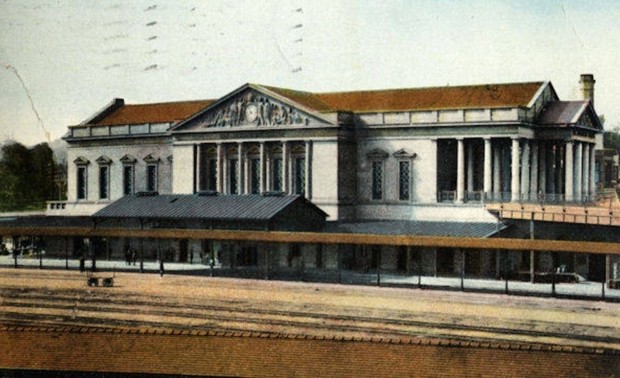
In 1930, just four years before his death, Omaha’s Burlington Station was renovated. The pitched roof receded under taller walls, the pillars were removed, and the central grand staircase that carried passengers to the concourse disappeared. The neoclassical revival overtaking American architecture hit Burlington station in 1930—the arched doorways and of the grand hall were replaced with flat doorways and everything became more linear, according to Kristi Nohavec, a structural project engineer who worked on the recent renovations.


Comments
Post a Comment